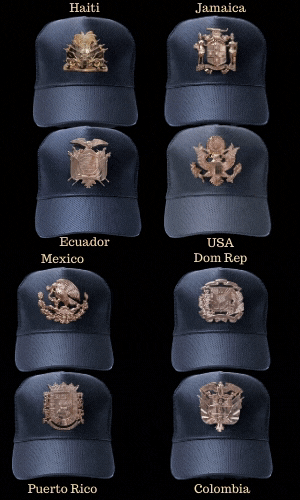



America has taken a slower, not as interested approach to soccer but in the last decade or so it has joined the rest of the planet—especially more now as World Cup is here and America has been gaining steam and respect.
Here’s your chance to get-up-to-speed on the world’s most watched sports competition.
There are nine-Spanish speaking countries in the World Cup. It’s the alpha-maie of top-class sport played at the very highest level. There’s no other event that produces such a packed schedule of encapsulating action.
If you’ve never watched the finals before or never been that into soccer, it’s easy to get pulled in especially if your country is playing with friends and family going crazy (I mean crazy as in loco/a) over their teams gooooooooooooooooooooooals!

But fear not, there’s still time to unashamedly jump on the World Cup bandwagon. Here are all the basic things to know about the World Cup to get you up to speed with the tournament format so you can enjoy the rest 2014 World Cup in Brazil to its full capacity.
1. The World Cup is the pinnacle of soccer
2. FIFA stands for: Fédération Internationale of Football (soccer) Association.
3. World Cup takes place every four years.
4. 32 national teams compete in a tournament held in one country over the course of about a month, with billions of people watching worldwide.
5. But in between each of these tournaments, there are hundreds of qualifying matches that win now the field down from 209 national teams to the 32 that make the final tournament.
6. The World Cup finals are a multi-stage tournament
7. The Group Stage: The World Cup is comprised of eight groups, each containing four teams. Typically, the hosts open the tournament with the first game, but occasionally the holders can kick things off. In the group, each team plays the other one time. A win will get you three points, a draw will get you one and naturally a defeat will get you zero. The top two teams from each group will qualify for the second round.
If two teams are tied on points, the side with the superior goal difference—the number of goals scored subtracted by the number of goals conceded—will progress.
The final two fixtures in the group stage are played at the same time, meaning that we can get some pretty dramatic moments as sides battle to make it to the last 16.
8. The Knockout Stage: The knockout format will see a team that finishes top of their group play a team that has finished second in theirs. So for example, the winner of Group A will player the runner-up in Group B, whilst the winner of Group B will play the runner-up of Group A.
Here’s the full tournament bracket for this year’s competition to provide you with a better understanding of how this works:

Aside from that, it’s all pretty self-explanatory. If you win you go through, if you lose you go home. Win four knockout games in a row, and you’re the world champions.
At this point, winning is all that matters; in the 2010 tournament, Spain won all of their knockout games 1-0 on the way to the World Cup final. They eventually won the trophy after another 1-10 win, but that was extra-time.
9. Extra-Time: If a knockout game is tied after 90 minutes, then the game will go to extra time. That involves 30 extra minutes where a winner can be decided. If a team is leading at the end of extra time, then they’ll progress.
With players jaded and managers often throwing caution to the wind, the game can be without rhythm or pattern. And that typically gives way to some extraordinary spells of soccer.
In the 2006 semi-final, Italy scored two late goals in a frantic extra 30-minute spell.
10. Penalties: If the scores are level after 120 minutes of action, the game goes to a penalty shootout to determine who progresses to the next round, or if the final is level after 120 minutes, to decide who lifts the trophy.
The shootout sees each team take five penalty kicks and whoever has scored the most at the end of the five kicks go through. If the score is level after five kicks, it goes to sudden death, where each team gets an extra kick. If one team scores, then other misses—or vice-versa—the team that scores will go through.
The World Cup final has only ever been decided on penalties twice, both times involving the Italian national team.