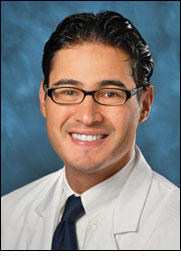


The skinny little kid who got beat up in his Montebello neighborhood made his way through Harvard Medical School and now performs complex, painstaking spine operations at Cedars-Sinai Medical Center.
He also does research aimed at using new young cells to fix crushed or crumbling spinal disks, and he’s working to organize a back-care program at a free clinic in the East Los Angeles area where he grew up.
Big opportunities didn’t knock often in the tough, predominantly Latino neighborhood where neurosurgeon Frank L. Acosta, Jr., M.D., got his start. But Acosta, 35, the son of a now-retired police detective and a legal secretary, found strengths in himself that propelled him through medical school and gave him compassion for the patients in his care.
He was an easy target most of his younger years, ending up bloodied and bruised often. Even the “cool” friends of his younger sister – she’s now a nurse at Cedars-Sinai – made fun of him.
“I was short and skinny and had big glasses. The only thing I can remember being able to control that made me feel good about myself was getting good grades. For some reason, I just knew that if I wanted to get a better life, the best thing I could do was get good grades,” says Acosta, director of spine deformity in Cedars-Sinai’s Department of Neurosurgery.
His parents divorced when Acosta was 3, and his dad moved to West L.A. His mom, who did her best to work and to raise two kids, couldn’t always be home when her son needed support.
“I often had to console myself to get through difficult times, and I think I developed some good coping skills I can share,” he says. “I know how tough it is to not have someone around who understands, and I get satisfaction when I can say to my patients, ‘I’m here for you.’”
Acosta took advanced classes, earned excellent grades in high school and applied to about 15 colleges – all the Ivies and prestigious colleges in California. He was accepted by all and chose to go to Harvard – at age 17.
“This was a real affirmation of my efforts and it had a lot of impact on my self-esteem issues. Getting on that plane to Harvard was everything I had wanted up until then. It was exciting, and it was nerve-racking. I knew I wasn’t the typical person going to Harvard. I had never been outside of L.A., had never seen snow, and I hadn’t been around many people outside of my ethnic group,” Acosta recalls.
When the excitement wore off, he quickly felt out of place in the tradition-bound Ivy League institution, where his first roommate was a third-generation Harvard student.
“I went from wanting to get out of East Los Angeles to really missing it. I missed my family but also, before I left, I had started to become accepted by some of the more popular kids in my social group. I remember thinking maybe I should have gotten a job on a construction site instead of going to Boston,” he says.
“But in my junior and senior years, I had this realization that my life was going to take a different course,” he adds. “I accepted it and started to accept Boston and Harvard, and I stayed there for medical school because I grew to like it so much.” He graduated magna cum laude from Harvard College in 1997 and earned his medical degree in 2002.
Acosta loved science as a kid and “wanted to have a career in something that was respected.” He imagined himself an engineer, a basic scientist or a doctor. Becoming an expert in complex spine surgery was an evolutionary process.
“When I went to college, I explored engineering and science classes and ultimately decided that part of what made me happy was being able to physically interact with people,” he says. “I started to lean toward medicine because I thought it would be a good way to apply this interest in science and have human interaction. I shifted toward surgery because it provides immediate gratification – you can look at a scan of someone’s body and see the results of your work. Neurosurgery is sort of pushing the edge of what we know about the human condition, touching on the brain and spirituality. It is intellectually challenging and to some extent unpredictable because everyone’s brain and anatomy is different. Neurosurgery bridges science and art.”
While in medical school, Acosta attended a presentation in which Keith L. Black, M.D., chairman of Cedars-Sinai’s Department of Neurosurgery, described the brain tumor research taking place at the medical center. Acosta applied for and received a Howard Hughes Medical Institute Fellowship, which enabled him to spend a year conducting research with Black’s group.
“This was a perfect opportunity to come back home, to spend a year doing very interesting research, and to work for Keith Black. All the pieces fell into place,” Acosta says.
After finishing medical school, he completed a general surgery internship and a neurosurgery residency at the University of California, San Francisco, before undertaking a fellowship at Northwestern University in complex and reconstructive spine surgery.
Acosta, who thrives on “big, challenging cases where you’re in surgery for eight or 10 hours,” joined Cedars-Sinai in 2009. The following year, he was named one of the 50 best spine specialists in America by Becker’s Orthopedic and Spine Review.
“I wanted to come back home to be close to my family and to help the community I grew up in. That made L.A. attractive,” he says. “Also, Cedars-Sinai is becoming a very significant leader as a model of health care, and a huge factor was getting to work with Keith Black again. This is sort of coming full circle, as a student and now as a colleague.”
Acosta has started volunteering in a small clinic for a predominantly Latino community in East Los Angeles, where he may start a specialized back program to help patients get the care they need. “We hope to do great things for this community and these patients who literally have nothing,” he says.