

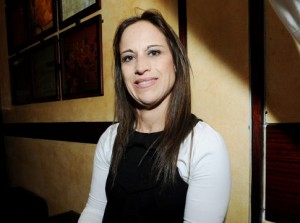
Pre-K teacher Sonya Gimondo faces her mortality daily – her rare heart condition always looming in the back of her mind, because it has already killed her.
Gimondo, who suffers from Brugada Syndrome, was pronounced dead at birth when her heart stopped beating. A minute later, she jolted back to life.
Because of her condition, she said, she felt a special connection to the plight of Omar Audi, the 9-year-old Astoria lad facing deportation while battling a life-threatening disease. She said she couldn’t bear to see young Omar struggle the way she had for so many years.
So she joined efforts last month with members of the Parent Teacher Association of Public School 234Q in Astoria, where she teaches, to help Omar stay in the country. The PTA contacted local politicians and raised more than $3,000 to help Omar’s family get legal representation.
Omar is being treated for hereditary angioedema, a disease that causes rapid internal and external swelling.
The boy and his parents, Dania Tafran and Rawi Audi, learned in November they would be deported back to their native Lebanon, and are currently appealing the ruling.
Gimondo recalls a police officer knocking on her car window at 1:30 a.m. one day in 2008. The police were responding to a call of a woman, presumably dead, in a car. They thought it was her.
She had fainted while driving home to Forest Hills from work. She managed to get the car stopped, but it was left awkwardly double-parked for more than seven hours, with her still belted into the driver’s seat.
“This [Brugada] should have killed me. It kills most people,” Gimondo, 47, said.
After a battery of tests, doctors noticed an abnormality in her electrocardiogram, and finally determined what had baffled so many in the past.
Her cardiologist, Dr. George Goldman, said the genetic disease that is “common in Asia,” and has no cure. Goldman said a disruption in the flow of sodium in the heart causes the heart to seize, and likened it to a “electical short circuit.”
Gimondo had a pacemaker/defibrillator implanted in her chest in September 2008.
She said she lost all sensation in her left side after a nerve was nicked during the implantation surgery, and her 100-pound frame had swelled.
As a result, she said, she couldn’t walk up two steps without being winded. In 2009, she could only manage small groups of students.
Gimondo said her optimism pushed her to build her endurance and rehabilitate. She now has a full classroom, plays tennis and the paralysis has subsided.
Gimondo’s brushes with death motivate her both in and out of the classroom. She said she knows she could die at any moment, but that doesn’t stop her from living in the now.
“I live every day like its my last because I think it’s a gift,” Gimondo said. “I’m here for today.”