


As the immigration debate in America becomes far more intense—particularly the standstill that’s going on in Washington regarding immigration reform—where do Latinos stand in-regards to their political alliance?
Democrats or Republicans: Who do Latinos side with?
Are Latinos preferring to side with Democrats or Republicans during this recent political climate?
In a report released during Obama’s presidency, it appeared that while Latinos aided in seeing President Obama receive another term as president, the group started to fall out of love with the president when it came to his job approval.
According to the polls back then, when asked on how President Obama was handling the border crisis 40% of Latinos approved of the president’s handling while 54% disapproved. However, the approval decline for President Obama amongst Latinos started far before the crisis along the border.
Back in December of that year a report was released that showed how in 2012 the job approval rating for President Obama stood at about 75% but it had fallen to 54% in November of 2013.
“Hispanic’ approval dropped 23 points over the last 12 months in 2013, the most among major subgroups, and nearly twice the national average. His approval rating also showed above-average declines among low-income Americans, nonwhites, moderates, and moderates who identify with or lean toward the Democratic Party,” said Jeffrey M. Jones, in his article, “Obama Approval Down Most Among Hispanics ” for Gallop Politics.
While Latinos may be losing their support of President Obama that does not mean they are losing faith in the Democratic party and opting to support Republicans or the GOP, the article stated.
READ: A LatinTRENDS Exclusive interview with Hillary Clinton
When it came to their approval of Republicans, only 23% of Latinos approved of the party’s effort in Washington. Meanwhile, 68% of Latinos disapproved of what the party was doing.
According to that Pew Research Center report released back in 2013 Latinos were increasingly approving and identifying with the Democratic rather than Republicans.
Despite the decline in approval of President Obama, the Pew report showed that Latinos would still stick with the Democratic when it comes to future elections. When it comes to a congressional race, Latinos have been reported to favor a Democratic candidate over a Republican by 63% favoring the former with 31% favoring the latter.
Although the polls showed that a 31% approval for Republicans amongst Latinos isn’t a bad thing for the GOP, it is when it comes to their approval back in 2012. The report showed that in 2012, the Republican party lost the Latino vote 71-27. During the midterm—which was held in 2010—the GOP stood at better odds among Latinos at 60-38.
Even though Republicans may not have the full support, or as high of support as the Democratic party, Democrats should not rest easy when it comes to “having” the Latino vote. If the political climate continues as it is when it comes to the immigration, health, and jobs. Both sides may find their approval rates dropping further if Latinos decide not to partake in the election process at all and not vote.
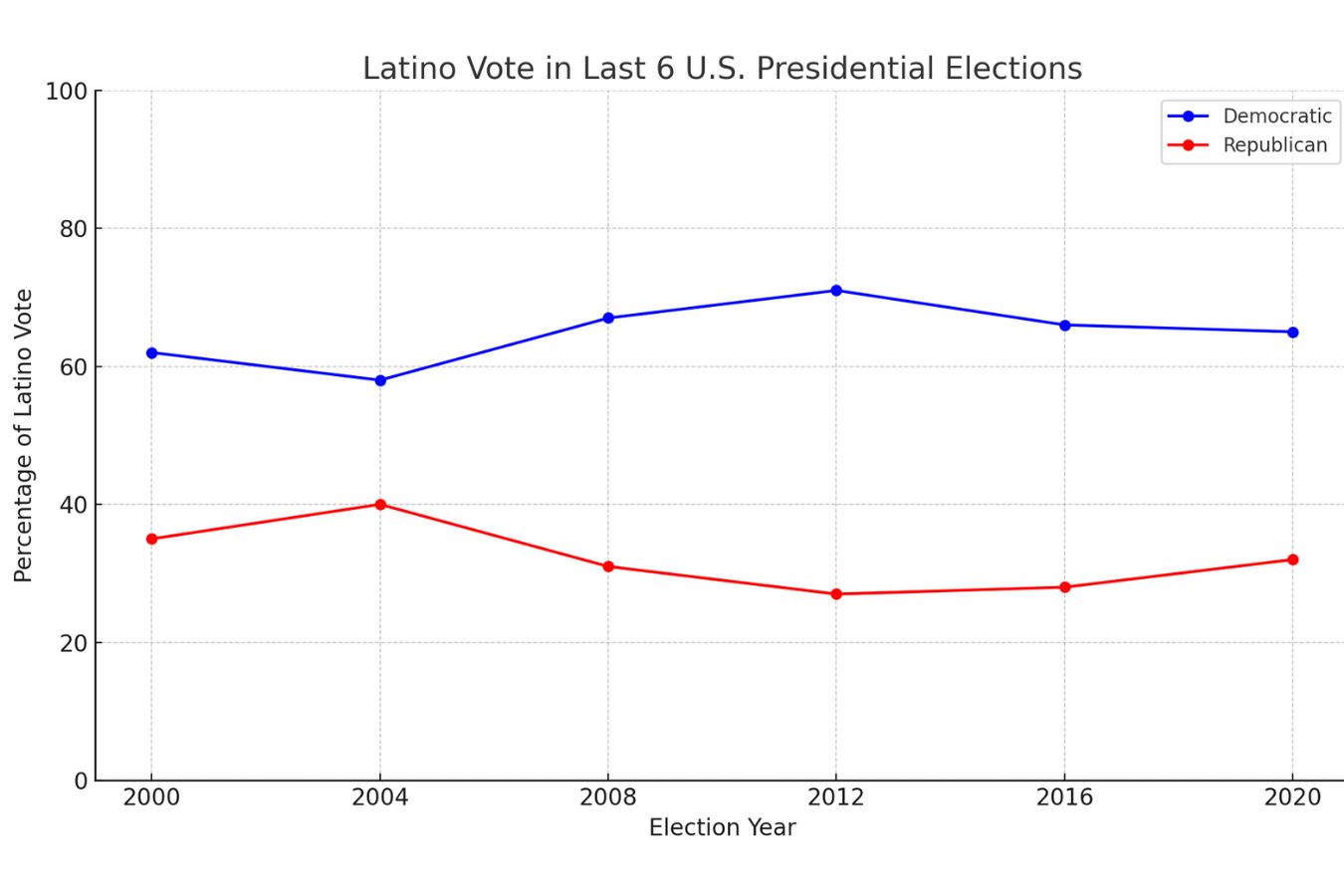 The Last Six Presidential Elections (2000 – 2020)
Over the last six U.S. presidential elections, the Latino vote has played an increasingly pivotal role. Historically, Latino voters have leaned Democratic, but there have been notable fluctuations and shifts that reflect the community’s growing diversity and evolving priorities.
In the 2000 election, Al Gore secured about 62% of the Latino vote, while George W. Bush garnered around 35%, a strong showing for a Republican. Bush improved his standing in 2004, winning approximately 40% of the Latino vote—thanks in part to his outreach and Spanish-language media strategy. However, Democrats saw a surge in 2008 with Barack Obama capturing about 67%, and he expanded that margin in 2012 with 71%, driven by support for immigration reform and healthcare access.
The 2016 election saw Hillary Clinton receive about 66% of the Latino vote, while Donald Trump managed around 28%—lower than Bush but higher than expected given his hardline immigration stance. By 2020, Joe Biden maintained a strong showing with 65%, while Trump improved to 32%, signaling a shift among some Latino voters, particularly men and those in Florida and Texas.
These voting patterns reveal that while Democrats still maintain a majority of Latino support, Republicans have made gains, especially among segments concerned with economic growth, religious values, and entrepreneurship. The Latino electorate is far from monolithic—and candidates in 2024 will need to engage this community with nuance and respect.
READ: Official Report Shows Immigrants commit less crime than US-born citizens
Trump vs. Harris, 2024 Presidential Elections
In the 2024 election, Latino voters were nearly evenly split between Harris and Trump:
This represents the narrowest margin among Latinos in recent decades, with Trump achieving the highest share for a Republican since the 1960s. While Harris retained a slim lead overall, Trump broke records with his gains in key subgroups—particularly among Latino men under 50 and in swing states like Florida and Texas
The 2024 elections saw a tight competition for Latino voters regarding Democrats and Republicans. It the closest the demographic has come to evenly dividing between the major party candidates. The percentage was:
- Kamala Harris, the Democratic nominee, received approximately 51% of the Latino vote
- Donald Trump, the Republican candidate, received around 48%
Key Observations:
- Trump’s near parity was driven in part by strong turnout and message resonance with younger Latino men, especially those focused on economic issues
- Among Latino men nationwide, Trump secured a majority, whereas Latinas still favored Harris—a pattern that narrowed the overall gap
- The shift toward Trump represents a 14-point increase over his 2020 Latino vote share—a historically large swing within a single cycle
Finalmente. Pero Importantisimo!
As the Latino community continues to grow in influence and numbers, so too does the power of its vote. With that power comes the responsibility to choose wisely. It’s essential not to be swayed by charisma, empty promises, or candidates who tailor their message just to win your support. Instead, take the time to listen, learn, and critically evaluate each candidate’s policies—not just their words, but their records and actions. Consider which party or individual offers realistic, meaningful solutions that align with both your personal needs and the broader interests of the Latino community. An informed vote is a powerful vote—make yours count.