

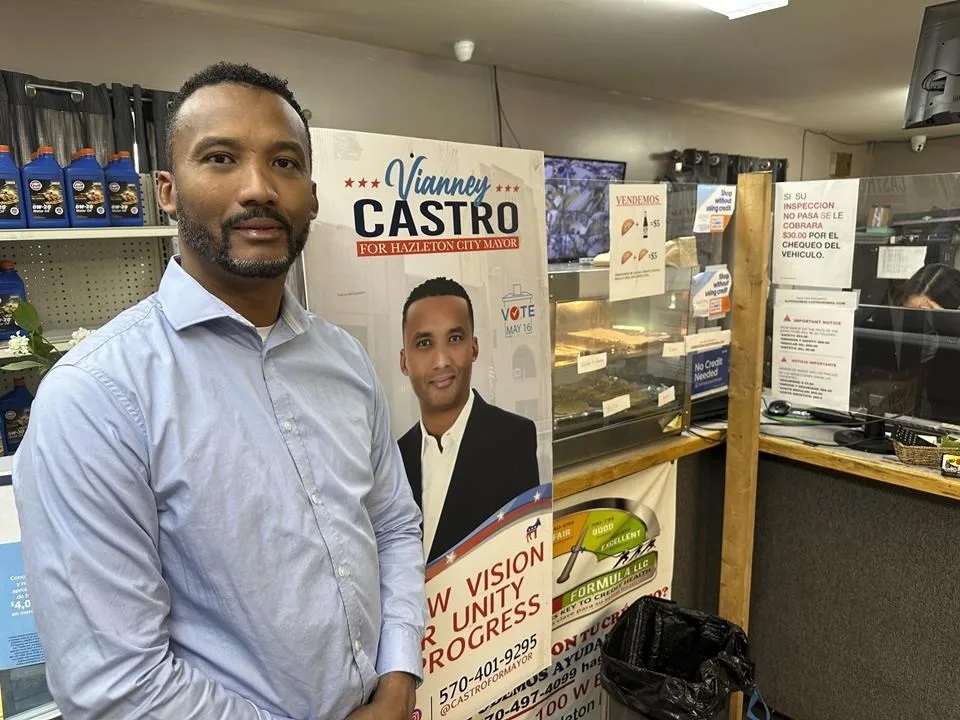
“We live in a very conservative area,” says Vianney Castro, a Dominican Republic native and Democrat who lost Hazleton’s mayoral race last November by about 25 points. “They resist change, but change is happening all around us.”
A federal lawsuit is challenging the election process for a local school board in Pennsylvania’s coal region, arguing it disenfranchises Latino voters.
Though nearly two-thirds of students in the Hazleton Area School District are Hispanic, no Hispanic has ever been elected to the school board. This has sparked a court case claiming that the district’s “at-large” election system is being used by non-Hispanic white voters to maintain control.
Over the years, Hazleton, Pennsylvania, has seen significant growth in its Latino population as people move in search of jobs and affordable housing. However, the lawsuit argues that the way school board representatives are elected prevents Latinos from gaining political power.
Two mothers of children in the district sued in February, seeking changes to what they see as an unfair system that weakens their voting power and violates the federal Voting Rights Act and the constitutional right to equal protection.
The district, with 78,000 residents, is about 55% white, 40% Hispanic, and 5% Black, Asian, or multi-racial. Hispanics are concentrated in Hazleton. This city is one of several in eastern Pennsylvania where growing Latino populations are starting to influence elections, including this year’s high-stakes presidential and Senate races.
The plaintiffs argue that the Hazleton board has shown a significant lack of responsiveness to the needs of Hispanic residents. Issues cited in the lawsuit include unfair student discipline, discriminatory student registration procedures, inadequate school staffing, a lack of qualified translators, and poor communication with parents.
For example, the district requires three separate proofs of address to register students, which can be challenging for new immigrants without stable housing. A bilingual sign at the administration building emphasizes this requirement, adding “must have three” and “no exceptions!” in handwriting.
Latino leaders highlight that many new residents struggle to provide these proofs and that school translators are often overworked. There’s also a perception that students with limited English skills face harsher discipline.
“We are in a very conservative area,” says Vianney Castro, who lost Hazleton’s mayoral race by about 25 points last November. “They refuse to change, but everything around us is changing.”
Tony Bonomo, president of the Hazleton Area School Board, acknowledges that electing representatives by region might be fairer but doubts the current board members will push for such a change. “We’re probably close to having that happen,” says Bonomo, a seven-term Democrat. “With a district that’s 60% Latino, something has to give.”
Last month, the school district’s lawyer sought to dismiss the case, arguing the plaintiffs aren’t entitled to sue under the Voting Rights Act and that voters are divided more by political affiliation than race or ethnicity. “Plaintiffs fail to show that Hispanic voters are politically cohesive or that white voters bloc vote to defeat Hispanic-preferred candidates,” the lawyer wrote.
The all-white, nine-member school board is elected at-large, a system adopted in 1989 amid disputes over spending. Previously, board members were elected from smaller regions within the district.
The Pennsylvania State Education Association notes that 310 of the state’s 500 school boards, like Hazleton’s, elect members at-large, while 175 use regional elections, and 15 employ a hybrid system.
The Hazleton board filled vacancies with non-Hispanics twice recently, the Hazleton Standard-Speaker reported in February.
A similar federal lawsuit in 2008 led the Bethlehem Area School District, about 50 miles from Hazleton, to create three geographic seats while continuing to elect six members at-large.
The influx of new residents has long been contentious in Hazleton. In 2006, the City Council approved the Illegal Immigration Relief Act, aiming to deny business permits to companies employing undocumented workers, fine landlords renting to them, and require tenants to register and pay for rental permits. A federal judge struck down the ordinance.
State Rep. Manny Guzman, a Democrat from Reading and vice-chair of the Pennsylvania Legislative Latino Caucus, says the state’s growing Latino population is experiencing growing pains as it seeks to convert demographic strength into political power. “We need to do better at turning out voters and building a local political bench,” Guzman says.
Earlier this month, the U.S. Justice Department supported the ability of private plaintiffs, like the two women suing the Hazleton district, to bring such challenges under the 1965 Voting Rights Act.