

Originally published in the May 2016 issue of LatinTRENDS magazine
By Clara Galvano-Rivera
From the beginning of time, groups of humans have migrated across this planet searching for adventure, food or opportunity. Unfortunately, some need to flee horrific circumstances. In his groundbreaking book Harvest of Empire, Juan González gives us a pretty clear picture of the conditions that create these crises. González, who has been a journalist for more than 30 years and former staff columnist for the New York Daily News, is also the co-host of the award winning daily radio and television news program “Democracy Now!”
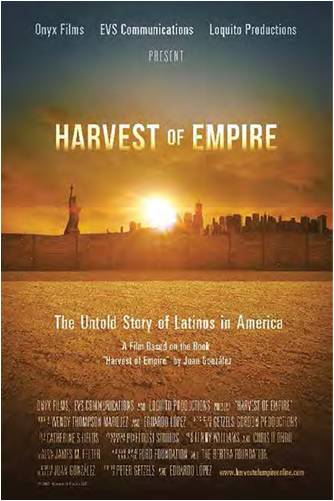
Luis Enrique, Emmy-winning singer and composer, wrote a song for the film about his experience in Nicaragua during the bloody war between the Sandinistas and the Contras. He says that there are two 15-year-old in him: The 15-year-old from before the war and the 15-year old from after. His song is very moving. Listen carefully, and you will hear sadness, pain, broken dreams, and, yes, anger. One woman, María, talks about being tortured. It takes a certain amount of courage and valor to share such unspeakable experiences, and the director’s lens is as kind as it can be in those circumstances. Juan González also shared his family’s migration to New York, as did Pulitzer Prize-winner Junot Díaz.
Although the book is being brought into schools and study guides to start a conversation between teachers and students, as well as their families and friends, a 90-minute documentary has now been created. Gonzalez shared, “When I was approached about this project, I was very interested because—although ‘Harvest of Empire’ is more comprehensive and carries a wealth of information that would be impossible to fit into a documentary—a film can capture the feelings, emotions and the visceral ways in which people relate to one another much better than a book can. You know, most people don’t really know why the explosion in the Latino population has been happening for the past 50 years. They don’t really understand it wasn’t an accident or freak of nature. I wanted them to understand what the forces were that made these people leave their homes, their families, and come here. I wanted people to see that the U.S. benefited from these migrations. These migrations were fundamental to our country’s development. The documentary will be able to open many eyes.” There are some strong scenes from Nicaragua, El Salvador, the Dominican Republic, Mexico, Cuba, and Guatemala.
Speaking with Gonzalez, he explains that migrations are not haphazard; they all have a reason. He mentioned that he was recently speaking at a function in Arkansas and that, in the past 10-15 years, many Guatemalans have taken root in the community. I asked him why. “Tyson Foods is there, and they needed labor to work in the chicken processing plant. Arkansas has not taken an anti-migration stance. They have been very welcoming to the Guatemalan population, and are very happy to have them in the community. This is not the case in states like Georgia, North Carolina and Alabama. The Guatemalan laborers,like all migrants, are risk-takers, and it’s worked out really well for them.”
Gonzalez goes on to say that many industries in the early days of U.S. expansion depended on cheap labor. Mexicans in the Southwest, for instance, were the reason that the 19th century King Ranch was so successful. At one point in time, there were 500 field hands on one ranch alone, all Mexican laborers. Mexicans were involved in the copper, sheep herding, cattle and gold industries, and made many companies rich by the sweat of their brow.
In 1820, the U.S. started to keep immigration data. Since that time,records show that Mexicans, not the Germans, French or Irish, are the largest group entering the United States. They were after all, close by. Mexico at that time was huge, and California, Nevada, New Mexico, Arizona, Colorado, Nevada and parts of Utah belonged to Mexico.There is a saying in the film that some people in Texas still use: “We didn’t cross the border, the border crossed us!”
We also spoke with Maria Hinojosa, executive producer of the long-running NPR show, “Latino USA” and anchor of the Emmy Award-winning talk-show “Maria Hinojosa.” Dr. Hinojosa has known Gonzalez since the late 1980’s. “As a young Latina journalist trying to make her way, I respected him and his work. Juan has become the People’s historian. He has helped us to understand who we are and where we come from. How did we get here? Most people don’t realize that the very first European colony was St. Augustine. St. Augustine was founded in 1565 by the Spanish, way before the English arrived. Central America and North America are deeply connected. Always have been. The history books that our kids are reading will reflect this true and honest history of the Latinos in the U.S.A. 2016 is clearly a year of change and transition. The center of any conversation is now about demographics. Any piece that can help uncover the complexities of how the cultures can co-exist and can clarify why Latinos are coming here is welcome. I hope people will see this documentary, step back and say: ‘I never knew that,’ and realize how intertwined our countries are. Media can have a good influence.”
Dr. Hinojosa thinks there has been too much division between genders, ethnicity, and people in general. And it certainly seems to be so at “the wall” that divides Mexico and the United States. According to Enrique Morones, Founder of Border Angels, more than 10,000 people have died trying to cross. He and volunteers take gallons of water into the desert to help those in need. Many migrants have died just from crossing the desert without enough water.
Hinojosa continues, “I was really surprised when I was asked to participate in this wonderful documentary. My part is pretty small and it happens at the end of the film. I was given the closing thoughts. That was really special. An important life lesson for me was when I met Elie Wiesel, who said to me that no human being can be‘illegal’, that we are all one, and that we have to see our common humanity.” Mr. Wiesel is a Romanian-born Jewish American writer, professor, political activist, Holocaust survivor, and Nobel Laureate.
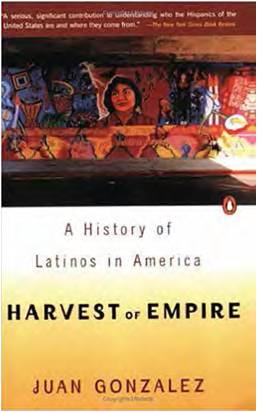
Harvest of Empire: A History of Latinos in America by Juan González is a Penguin book available in bookstores and online. Get this book. It is a game-changer. Watch the Harvest of Empire 90-minute documentary based on the ground-breaking book by Juan González, which includes special cameos by Junot Díaz, Geraldo Rivera and more: www.linktv.org/shows/episodes/harvest-of-empire-full-film