


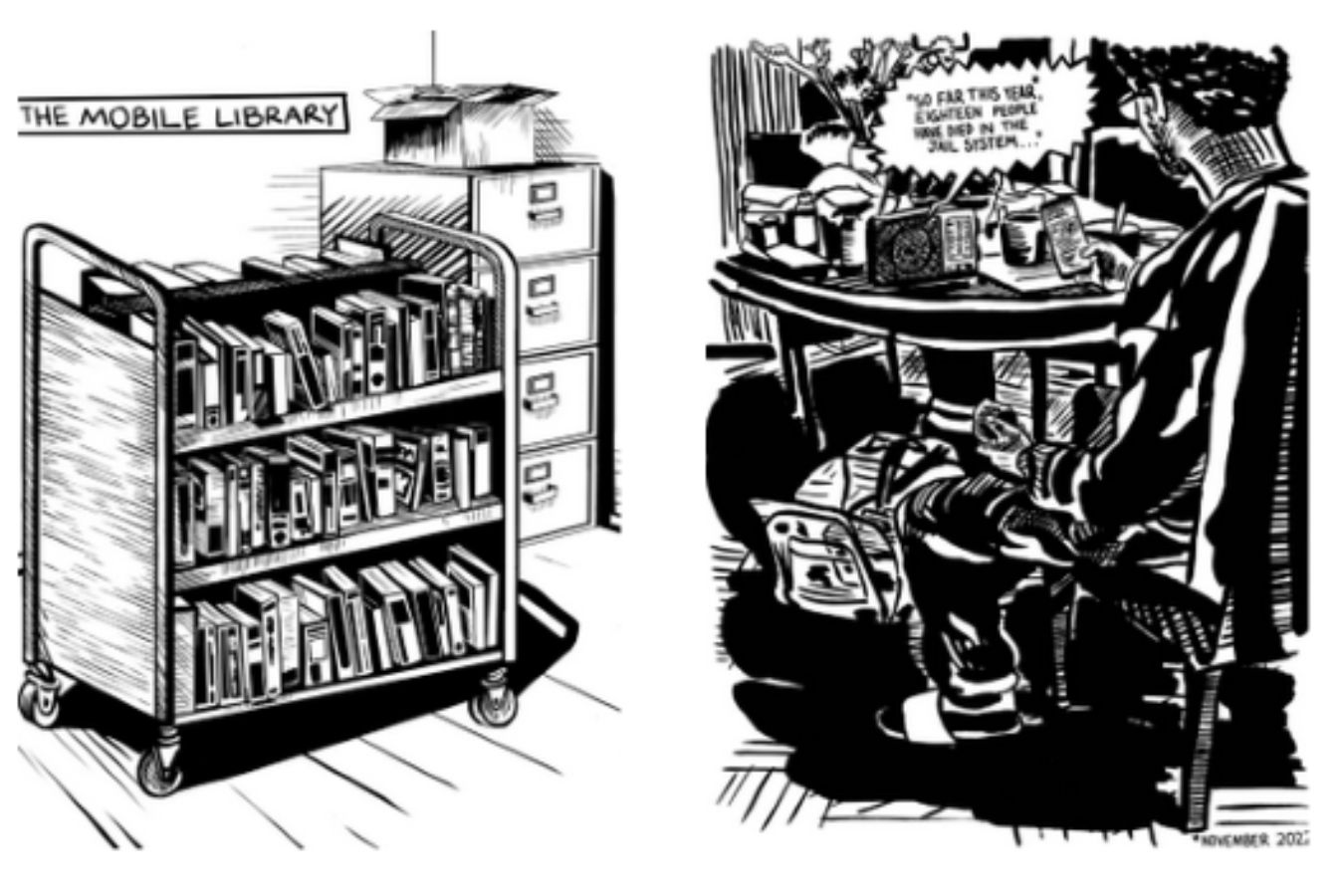
A rickety book cart labeled “THE MOBILE LIBRARY” sits in a corner, brimming with books. An inmate stretches his arm through the bars of his cell, reaching for his next escape in the form of a story. Meanwhile, a prison library assistant quietly takes note of it all, documenting moments that few ever witness. This is Medar de la Cruz’s Pulitzer-Winning glimpse Into Rikers.
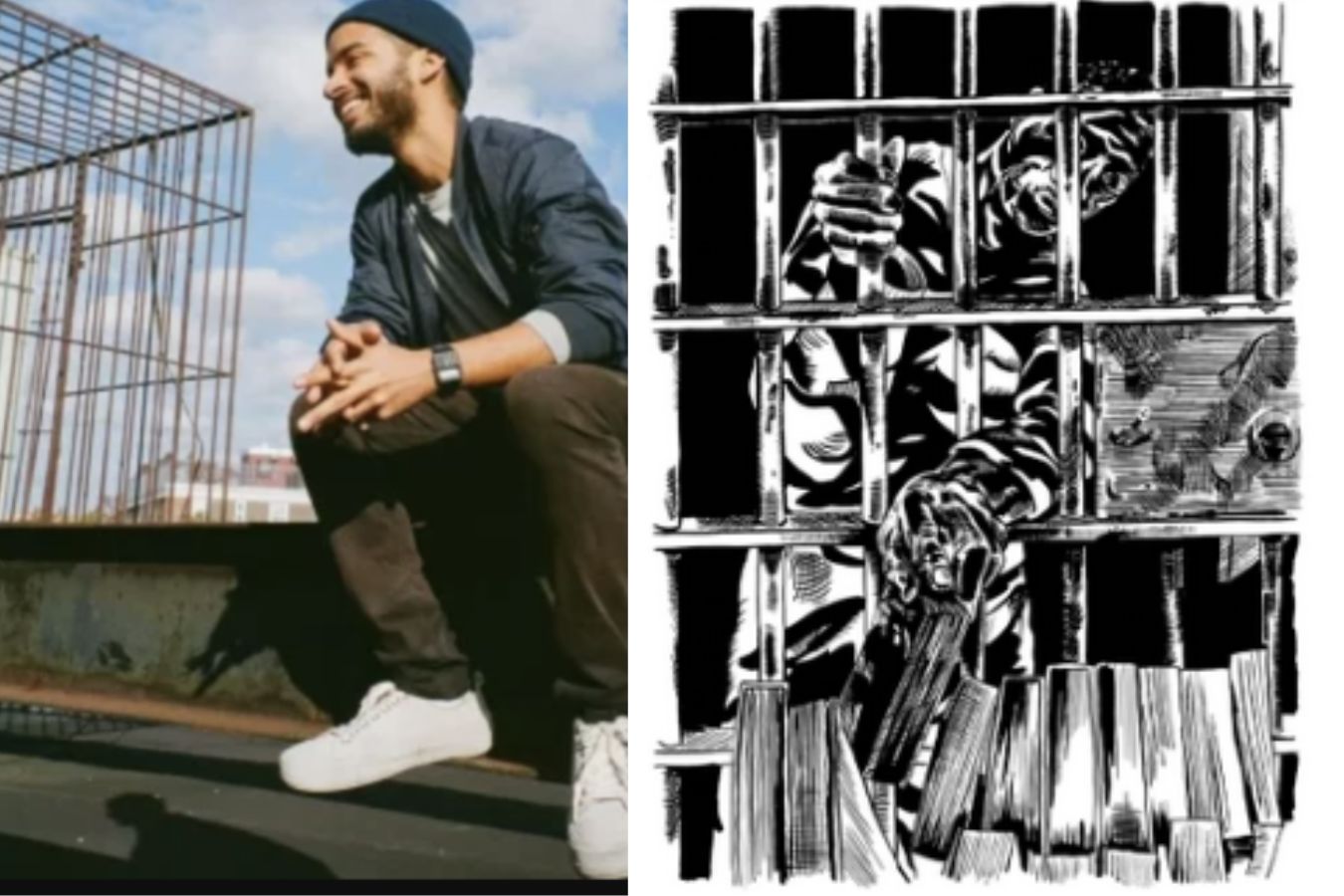
Medar de la Cruz, a comics artist and library assistant for the Brooklyn Public Library, has turned his firsthand experiences inside Rikers Island into award-winning art. His piece, The Diary of a Rikers Island Library Worker, published in The New Yorker, won the 2024 Pulitzer Prize for Illustrated Reporting and Commentary. Through his powerful illustrations, de la Cruz offers a rare, intimate look at life inside one of the nation’s most infamous jails.
Rather than following a structured narrative, de la Cruz’s work is a collection of snapshots—glimpses into the daily struggles, quiet moments, and small acts of humanity that unfold behind bars. His drawings are almost entirely wordless, save for the occasional speech bubble capturing a passing conversation or the ironic, bold-lettered “MOBILE LIBRARY” sign.
Rendered in stark black-and-white brushstrokes, his illustrations convey both the weight of confinement and the fleeting moments of light within it. Heavy ink saturates the cold, unforgiving corners of the jail, while delicate cross-hatching brings to life the faces of those who inhabit it.
Read: The Notorious Flores Twins Teach Cops How to Catch Cartels
“Phones and cameras aren’t allowed on Rikers, but I’m an illustrator,” de la Cruz wrote in his piece. “Sometimes I saw things that I felt compelled to draw from memory later.”
That memory-driven approach adds an emotional depth to his work. One particularly haunting illustration frames a cell door, through which only a sliver of an inmate’s face is visible. “Do you got any self-help books?” he asks, his voice captured in a lone speech bubble. The image lingers, a quiet yet profound reminder of the desire for growth, even in confinement.
Illustrated reporting is a perfect fit for a place like Rikers, where traditional media access is heavily restricted. The Pulitzer category itself, though still relatively new, has been a home for unconventional visual storytelling. This year’s finalists included an almost wordless political cartoon series, a deeply personal illustrated essay comparing a toddler’s language development to ChatGPT, and a Washington Post comic exploring the history of Filipinos exhibited at the 1904 World’s Fair.
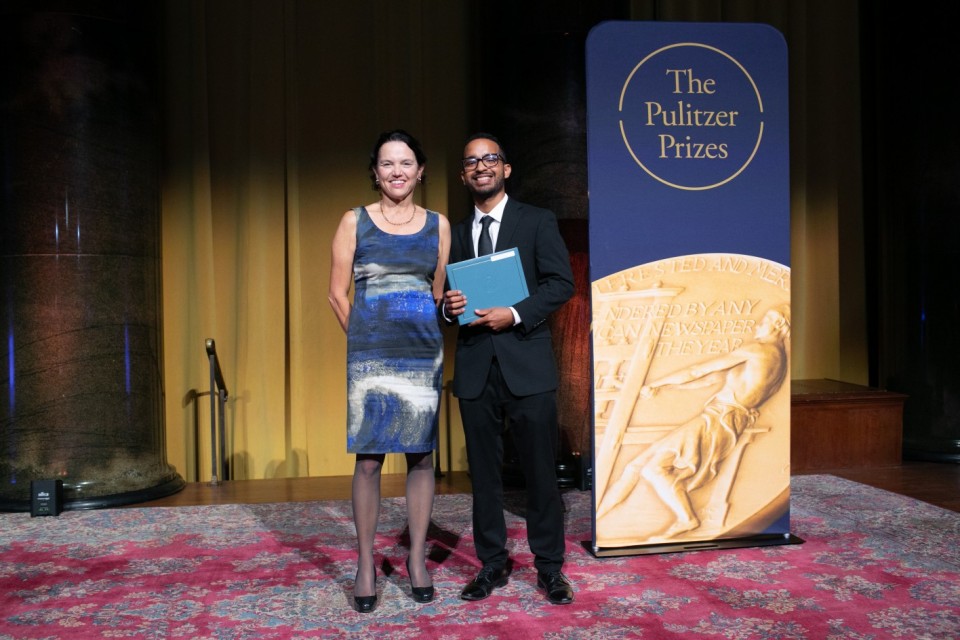
Since its creation in 2022 as a successor to the Editorial Cartooning category, the Illustrated Reporting and Commentary award has recognized a diverse range of artistic storytelling. Both de la Cruz and last year’s winner, Mona Chalabi, are independent illustrators, proving that this category is not limited to full-time newsroom staffers.
De la Cruz’s work highlights the power of non-traditional journalism—where words fail, images speak. And for those living within Rikers’ walls, a book, a picture, or even a fleeting conversation with a library worker can be a small but meaningful escape.
De la Cruz. Joins this illustrious group of Pulitzer Prize Recipients: (below)
Fiction:
- Oscar Hijuelos: In 1990, Hijuelos became the first Hispanic writer to win the Pulitzer Prize for Fiction with his novel The Mambo Kings Play Songs of Love.
- Junot Díaz: Awarded the Pulitzer Prize for Fiction in 2008 for The Brief Wondrous Life of Oscar Wao.
- Hernan Diaz: Co-recipient of the 2023 Pulitzer Prize for Fiction for his novel Trust.
Journalism:
- Liz Balmaseda: Won the Pulitzer Prize for Commentary in 1993 for her columns on the plight of Haitian and Cuban refugees.
- Sonia Nazario: Awarded the Pulitzer Prize for Feature Writing in 2003 for her series “Enrique’s Journey,” chronicling a Honduran boy’s journey to the U.S. in search of his mother.
- Alejandra Xanic von Bertrab: In 2013, von Bertrab, a Mexican investigative journalist, shared the Pulitzer Prize for Investigative Reporting with David Barstow for their work on Walmart’s use of bribery in Mexico.
- Maria Hinojosa: A Mexican-American journalist, Hinojosa won a Pulitzer Prize in 2022 for her work with Futuro Media.
- Silvia Foster-Frau and Arelis Hernández: In 2024, these journalists of Puerto Rican descent were awarded the Pulitzer Prize for National Reporting for their examination of the AR-15 semi-automatic rifle.
Drama:
- Nilo Cruz: In 2003, Cruz became the first Latino to win the Pulitzer Prize for Drama with his play Anna in the Tropics.
Memoir or Autobiography:
- Cristina Rivera Garza: A Mexican author, Rivera Garza won the 2024 Pulitzer Prize in this category for her book Liliana’s Invincible Summer: A Sister’s Search for Justice.
Where is De la Cruz from? What is he up to?
Medar de la Cruz is a Dominican-American cartoonist and illustrator born in Miami, Florida, and currently residing in Brooklyn, New York. He graduated with a degree in illustration from the ArtCenter College of Design in Pasadena, California. Throughout his career, de la Cruz has worked as a freelance illustrator for esteemed publications such as The New York Times and The New Yorker.
Beyond his illustration work, de la Cruz contributes part-time to the Outreach Department at the Brooklyn Public Library, where he provides book cart services to incarcerated individuals on Rikers Island. This experience has inspired him to explore the role of journalism in his autobiographical comics. Currently, he is working on a graphic novel about his experiences at Rikers, aiming to offer insights into spaces that are otherwise inaccessible to the public. In addition to creating comics, de la Cruz serves as an educator, sharing his passion for visual through community workshops across New York City.