

Meet Padre Fray Tormenta, the wrestling priest who’s not your average clergyman. Picture this: it’s a chill Sunday morning in December, and Padre Fray Tormenta is soaking up the sun in front of his 17th-century church. No fancy outfits in this humble neighborhood, not even for the church, which has seen better days with its chipping yellow exterior. But Padre Fray Tormenta is not your ordinary priest; he’s the man who’s not just about sermons and hymns.

As the churchgoers trickle in, he glides through the courtyard in his purple robe, flashing smiles at the old ladies and signing autographs for the kids. And if you think that’s where the story takes a holy turn, you’re in for a surprise.
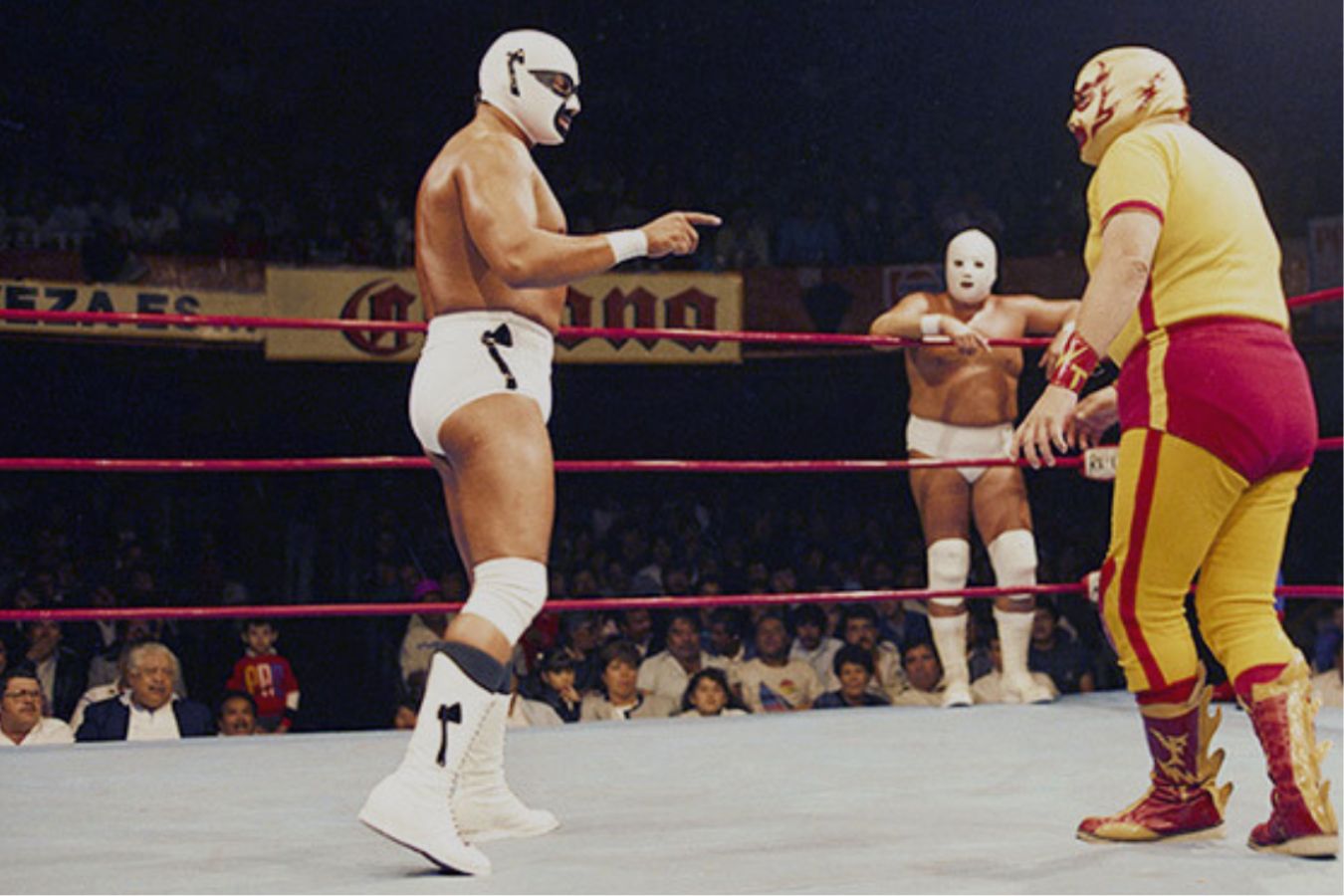
Because when the crowd thins, Padre Fray Tormenta disappears into his office and emerges wearing a lucha libre mask – yellow and red, to be precise. Yes, you read that right – the wrestling priest is about to take center stage.
But this isn’t the famed Arena México; it’s Parroquia San José in Texcoco. The priest turned luchador struts down the aisle, trailed by altar boys in tattered cassocks.

He’s not just any showman; he’s the man who designed his own mask. “The yellow is for the liveliness Fray Tormenta must display in the ring. The red is for the blood that Fray Tormenta must spill on behalf of his orphanage,” he explains.
As he stands before the pews, folding his mask ceremoniously, you realize this isn’t your average Sunday mass. Padre Fray Tormenta starts the liturgy, but his mannerisms are pure showmanship, as if he’s about to step into the wrestling ring. And with that, the wrestling priest’s alter ego seamlessly blends with his clerical duties.
The next day, seated in his office, Padre Fray Tormenta reflects on a decision made 40 plus years ago. Back then, he was Sergio Gutiérrez, a seminarian with a troubled past.
Sent to Veracruz, he faced a hostile parishioner challenge – fight for their respect or leave. The moment he decided to take a beating for their acceptance marked a turning point, though not the final vow moment.
Veracruz, where Cortés began his conquest, became the backdrop for Padre Fray Tormenta’s transformation. But his journey isn’t a straightforward narrative; it’s a blend of folklore and reality, much like the wrestling matches he’d later engage in.
Born in poverty, Sergio’s life took a dark turn in Mexico City’s slums. But a pivotal moment, wrongly accused of murder, led him to seek help from a priest. Disappointed by the lack of compassion, he realized the need for “cool priests” who could make a difference. So, he decided to become one.
From fighting personal demons to facing challenges in seminary, Padre Fray Tormenta emerged transformed.
His journey took him to Europe, where he studied and learned valuable lessons about life, philosophy, and theology. Sent to Veracruz, he embraced the chaos of a parish filled with addicts, sex workers, and delinquents.

His story, however, takes on mythical proportions, with versions differing, as if narrated from a magical realist novel. Yet, one thing remains consistent – his dedication to orphans.
Padre Fray Tormenta’s life is marked by grand gestures, a collage of memories and photographs on his desk, and health challenges that amplify the sense of a nearing end.
The tale takes an unexpected turn when he enters the world of lucha libre. Training in secret, he eventually steps into the ring, donning a mask inspired by a 1963 Mexican film, “El Señor Tormenta.” His journey as a wrestling priest begins, but not without controversy.
The diocese disapproves, and a bluff leads to reluctant acceptance – if the church gets a share of his wrestling earnings.
The wrestling priest’s dual life unfolds – in the ring, he’s Fray Tormenta, with finishing moves like “La Confesora,” while outside, he continues his ministry. His identity as a luchador becomes public, but it doesn’t overshadow his clerical duties.
He ministers to fellow luchadors, celebrates masses at the Arena México, and even blesses contemporary lucha libre stars like Místico.
With fame comes financial gain, and Fray Tormenta starts making money globally. He navigates the backstage chaos of lucha libre, maintaining a balance between his roles. However, challenges persist, with the bishop objecting to the blending of religion and wrestling.
A clever bluff secures the bishop’s reluctant approval, allowing Padre Fray Tormenta to continue his unconventional journey.
His life story, immortalized in films like “The Man in the Golden Mask” and “Nacho Libre,” brings financial gains that he channels into building orphanages. Health issues become apparent, but Padre Fray Tormenta adapts, leveraging his fame to release a CD and explore new avenues for fundraising.

As we wrap up the story, Padre Fray Tormenta reflects on the essence of his unconventional journey. A rubber band analogy captures his approach to the church’s rules – stretching them, but not breaking them entirely. He emphasizes the importance of performance in his identity, whether in the priesthood, wrestling, or music.

In a tour of his church, we see the realities of Padre Fray Tormenta’s life – cramped bedrooms for the boys he’s cared for, a kitchen overrun with flies, and a meager refrigerator. The paintings of the Virgin of Guadalupe, fallen and in need of repair, symbolize the challenges he faces.
But amid the struggles, Padre Fray Tormenta emphasizes that fame was never his pursuit. It was about helping others, especially the boys he’s cared for over the years. The luxuries he lacks, he gladly sacrifices for the well-being of those under his care.
Padre Fray Tormenta’s story is a unique blend of folklore, wrestling theatrics, and a genuine commitment to serving others. His legacy, as the wrestling priest who defied norms, continues, leaving an indelible mark on the intersection of faith and lucha libre.