

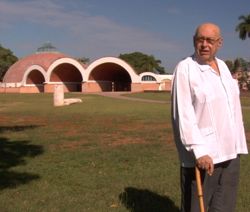
Unfinished Spaces, an award-winning new documentary by Alysa Nahmias and Benjamin Murray, will have its broadcast premiere on PBS as part of Latino Public Broadcasting’s arts and culture series VOCES ON PBS on Friday, October 12, 2012, 10:00-11:00 p.m. ET (check local listings), in conjunction with Hispanic Heritage Month.
In 1961, three young, visionary architects — Robert Gottardi, Ricardo Porro and Vittorio Garatti — were commissioned by Fidel Castro and Che Guevara to create Cuba’s National Art Schools on the grounds of a former golf course in Havana. Construction of their radical designs began immediately, and the school’s first classes soon followed. Dancers, musicians and artists from all over the country reveled in the beauty of the schools, but as the dream of the Revolution became Sovietized, the project was suddenly denounced as bourgeois and counter-revolutionary, and construction was abruptly halted.
Using these radical, magnificent buildings as a prism through which we see the turbulent, ever-shifting history of Castro’s Cuba, Unfinished Spaces follows the fates of the three architects, now in their 80s, who may now get a second chance to revitalize their utopian project.
* * *
Produced by Latino Public Broadcasting, VOCES ON PBS is the only national television series devoted to exploring and celebrating the rich diversity of the Latino cultural experience. The series will air on four consecutive Friday nights at 10PM, beginning on September 28, 2012. Other films in the series are Tales of Masked Men (September 28), Escaramuza: Riding from the Heart (October 5), and Lemon (October 19). Funding for VOCES was provided by the John D. and Catherine T. MacArthur Foundation. In addition to its national broadcast, VOCES will also be available for free viewing online via the VOCES website. For complete information, visit www.pbs.org/voces.
About the Architects
ROBERTO GOTTARDI is one of Cuba’s most well-respected architects. He has lived in Havana since 1959, when he was invited to collaborate with Porro and Garatti on the design of the School of Theater at the National Art Schools complex. Unfortunately, because Cuba has not been financially able to construct many buildings, Gottardi has only been able to complete small works, such as a tourist pizzeria in the Capitolio district of Havana. After teaching architecture to generations of Cuban youth, he recently retired and his daily life is part of “la lucha,” or “the battle” fought by Cubans on a daily basis against hardships such as food shortage, blackouts, and lack of medical supplies. Gottardi has re-drawn his plans for the completion of the School of Theater over ten times since the announcement of the restoration of the buildings in 1999. Lamentably, restoration has not yet begun in spite of his efforts and enthusiasm.
RICARDO PORRO is the architect of the Schools of Plastic Arts and Modern Dance at the National Art Schools complex. A native Cuban, he participated in the early stages of the Cuban Revolution. As a student during the 1950s in Havana, Porro was so central to
the student movement that he was forced to flee Cuba for Venezuela for two years prior to Castro’s coup. In Venezuela he met Gottardi and Garatti, the Italian architects whom he later invited to join him in Cuba after the triumph of the Revolution. Porro’s interdisciplinary, poetic approach to architecture stems from his early encounters with masters of modern art and architecture such as Picasso and Le Corbusier. Porro was a close friend of legendary Cuban painter Wilfredo Lam and a painting by Lam was the only possession Porro was permitted to take with him into exile in Paris in 1967.
VITTORIO GARATTI designed the Schools of Ballet and Music at the National Art Schools complex. After working in the office of Milanese architect Ernesto Rogers during the 1950s, Garatti left Italy and joined the Banco Obrero urbanist project in Venezuela. In Caracas, he met Porro and Gottardi, his future collaborators and lifelong friends. In 1974, Garatti was arrested, imprisoned for twenty-one days, and expelled from Cuba. Since then, Garatti has maintained an architectural practice in Milan and a distinguished teaching career at the Milan Politecnico School of Architecture. Garatti remains dedicated to the original ideals of the Cuban Revolution and, when he visits the art schools buildings in ruins as they are today, he sees metaphors of the Revolution itself: a mixture of nostalgia and imperfect beauty.
About the Filmmakers
ALYSA NAHMIAS (Co-Director/Co-Producer) is founder and executive director of Ajna Films. Filmed over the course of ten years, Unfinished Spaces is her feature directing debut, for which she won a 2012 Independent Spirit Award. Her producing credits also include The Listening Archive and Outside the Giardini. She has received numerous grants and awards from government agencies and private foundations, including the New York State Council on the Arts, the Jerome Foundation, and the Graham Foundation. Nahmias holds a Masters degree in architecture (M.Arch) from Princeton University and a B.A. from New York University’s Gallatin School of Individualized Study.
BENJAMIN MURRAY (Co-Director/Co-Producer/Director of Photography) started his post production company, The Room, in 2010 and currently partners with Technicolor through two Flame Premium suites. His regular clients include major networks and numerous independent production companies. Murray’s recent projects include No Direction Home, directed by Martin Scorsese; Capitalism: A Love Story, directed by Michael Moore; The Promise: The Making of Darkness on the Edge of Town, directed by Thom Zimny; Client 9, directed by Alex Gibney; Reagan, directed by Eugene Jarecki; and Fog of War, directed by Errol Morris. Murray holds a BFA in Film and Television Production from New York University’s Tisch School of the Arts.
About Latino Public Broadcasting
Latino Public Broadcasting is the leader in the development, production, acquisition and distribution of non-commercial educational and cultural media that is representative of Latino people, or addresses issues of particular interest to Latino Americans. These programs are produced for dissemination to public broadcasting stations and other public telecommunication entities. Latino Public Broadcasting provides a voice to the diverse Latino community throughout the United States and is funded by the Corporation for Public Broadcasting. More information about VOCES is available at VOCES on Facebook or Twitter.