

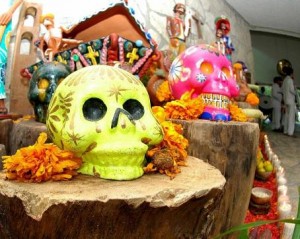
Mexico celebrates the Day of the Dead on November 1st and the 2nd. The tradition suggests the belief that between October 31st and the day of the celebration, the souls of the dearly departed roam the earth to enjoy the pleasures they had in their earthly life. The holiday is meant to honor those who have passed, and celebrate their life.
As a result of the mixing of cultures and their Catholic and Mayan antecedents, the days of the dead are a time of great family togetherness in which the whole family take part and everyone is involved.
Throughout the state of Quintana Roo, “Hanal Pixan” -as the Day of the Dead is known within the Mayan tradition- is one of the most significant traditions, due to all the preparations involved: the building of beautiful altars, adorned with palm crosses, candles, drinks, pictures and the “deceased’s” favorite food comes to life. During “Hanal Pixan”, people pray and sing, sweep the yards and paint the walls to receive the dead with full honors.
Gastronomically, “Hanal Pixan” is a celebration that bursts with flavor. Large portions of the best dishes are prepared, with the idea that the souls enjoy earthly pleasures such as food. Proof of this is the Mucbipollo, from the Mayan “Pib” which means “buried” and is a tamale or corn cake stuffed with chicken, sauce, broth and spices, cooked in a hole in the ground and covered with banana leaves. All the food is arranged on the altars for the souls to have their feast. The belief dictates that the offered food looses its flavor and nutrients by the next day.
Day of the dead was declared in 2003 as a World’s Cultural Heritage Site by UNESCO, due to the importance it has on Mexican indigenous communities’ everyday lives regarding the different dimensions and perceptions of death.