


 by: John Rodriguez
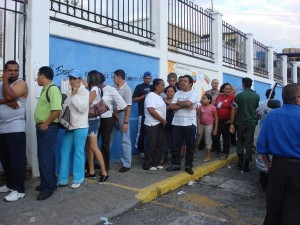
If you happen to visit the country which has seen numerous revolutions, the seesawing rise and fall of oil prices, and sporadic construction projects that reshapes the metropolis’s exterior the one thing you are sure to see that never truly changes are its citizens standing within lines. Whether it is to visit the bank, enter government offices, go into hospitals, to such trivial things as hair salons, grocery stores, and even the cinemas lines are erupting out from the buildings onto the city’s sidewalks.
Lines are so long within Venezuela, at a tower where the country’s National Assembly and other courts are held within a total of 117 people stood in a single slow-moving line. Similar sights can be found in downtown areas where lines stretched from within the buildings of Supreme Court, Social Security Institute, and Foreign Relations Ministry heading outside and around the building’s exterior.
For columnist Jorge Sayegh, of the newspaper El Universal, “Lines for us are like a spouse from time immemorial whom we cannot stand, but without whom we cannot exist,” Sayegh wrote this observation about Venezuelans this year in the paper describing the odd need and acceptance of having to put their lives on pause and simply wait. He goes on to describe the peoples’ acceptance, and possibly fondness, of lines by stating that “we’re attracted to lines like flies to honey; we actually love them.”
To each their own comes to mind, to each their own. But is this true? Do Venezuelans who have to stand on these never-ending-like lines enjoy them? See them as a daily function in their lives? No, not really. For some, enduring these never-ending lines has become an encroaching contentment over having to endure hours standing in one.
Standing in a line to pay her electric bill at a government -owned facility, Thais Estrada, a 62-year-old retiree, reviews her situation of having spent a lifetime standing on lines and concludes, “Why make yourself upset over such a thing?” And finds the wait somewhat rewarding because, “Standing in line is a chance to make new friends. After sharing this experience, we’re virtually cousins now,” She adds with a smile while addressing a woman waiting in line with her. “There are people embittered about standing in lines, but this is our system and we adapt to it.”
There are lines to even purchase food. A graphic designer, Yahaira Reyes, 42, stood in four different lines when buying subsidized groceries. Waiting on line to buy food is the routine since authorities in the country have declared control over the food distribution industry. And for Reyes, that is not a problem since “people who complain about lines are wasting time. When I see a line for good food at low prices, that’s where I want to be.” Clearly becoming content with having to stand on lines has settled in for Reyes like so many other Venezuelans.
Scholar and Economists have tried to explain why Venezuela has adapted a line-standing culture. Some have concluded that is oil and the byzantine state bureaucracy that united to manage its petroleum revenues is the culprit for the sea of lines. Others view the blame should fall on President Hugo Chávez who has pumped the bureaucracy with steroids by nationalizing dozens of private companies and raising the number of ministries from 14 to 27 when he rose to power in 1999. What does this all mean? Well, the country has become one very large Department of Motor Vehicles.
If you were to look into the history of Venezuela, you would find these lines are not so new to the country. In Erna Fergusson’s “Venezuela” published back in 1939, Fergusson documents the series of lines she came across after traveling to Venezuela after Dictator Juan Vicente Gómez 27-year rule of the country ended. Describing the continual lines she endured, Fergusson wrote that “Venezuela proved to be as difficult to leave as she is to enter. For me, it was only a hot and wavering daze.” The description comes from Fergusson having to stand in lines of five different offices to obtain stamps, seals and permissions, and a petition from the City Council which would allow her to leave the country.
But the lines into buildings are just a prerequisite. Paula Espinosa, 42, stood on a line to get a copy of a wedding certificate, however the line she was standing in, while outside, was just to gain access to the building’s one functioning elevator and would face other lines when she officially entered the building itself. So while standing outside, listening to the honking horns, bellowing cars alarms, and the revving of engines screech by flipping through magazines, humming melodies, texting or talking away on phones, and simply drifting off into space provides a escape from the mundane wait. So, standing in a D.M.V seems a tad more appealing now.